

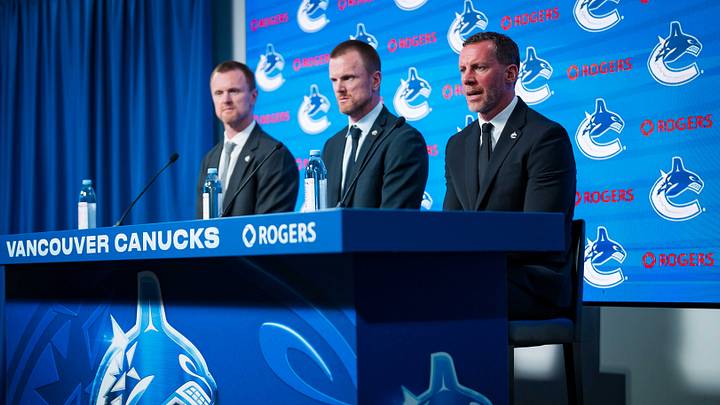
On May 18th, co-presidents Daniel and Henrik Sedin and general manager Ryan Johnson took over the front office for the Vancouver Canucks and, in doing so, inherited a long "to-do" list. In politics, 100 days is an arbitrary period of time used by heads of state to show the electorate how they plan to execute their short- and long-term plans.
In that vein, today is the 100th day of the Sedin-Johnson era in Vancouver. Therefore, it is a good time to break down how much they have accomplished and assess how effective they have been.
1. New coaching staff: Grade B+
Former head coach Adam Foote, along with his assistants Kevin Dean, Scott Young, and Brett McLean have been replaced by new head coach Manny Malhotra and assistant coaches Ryan Mougenel, Jordan Smith, and Jason Krog. Andrew Shaw is the new assistant to the video coach.
General Manager Ryan Johnson announced today that the #Canucks have named Ryan Mougenel, Jordan Smith, and Jason Krog Assistant Coaches, and Andrew Shaw as Assistant to the Video Coach.
— Vancouver Canucks (@Canucks) July 10, 2026
DETAILS | https://t.co/RpUAZCgp7t pic.twitter.com/857qvOGqen
Malhotra coached the Abbotsford Canucks, the Vancouver American Hockey League (AHL) affiliate, for the last two seasons. That was after being an assistant coach for the Toronto Maple Leafs from 2020-2024. Despite winning the Calder Cup in 2024-25, Ryan Johnson was more impressed with how Malhotra did when the team struggled last year. He felt that, with the team entering a rebuild, "where you're going to have some adversity with some young players that need consistency and support...he was the guy."
Mougenel just won the Louis A. R. Pieri Memorial Award for the AHL's most outstanding coach with the Providence Bruins, and his strengths lie "as a teacher, communicator, and culture-builder". The other three assistants had been on Malhotra's staff in Abbotsford.
Although there is poetry and symmetry in having a rookie coaching staff grow in unison with a rebuilding team, not having any NHL coaching experience behind the bench is risky. Since 2000, six head coaches have won the Stanley Cup after winning the Calder Cup, but they all had experienced assistant coaches when they started.
As a result, the grade fell just short of an A.
2. Hiring the "hockey nerd": Grade D
Aiden Fox remains the Head of Hockey Analytics and has the support of the new leadership. However, the last seven Stanley Cup-winning organizations have had very strong analytics departments. Many teams have similar front office vacancies this off-season, as the Canucks chose to hire "hockey nerds": Sunny Mehta (GM, New Jersey Devils), John Chayka (GM, Toronto Maple Leafs), Chris MacFarland (GM, Nashville Predators), and Evan Gold (AGM, New York Islanders).
On the other hand, the Canucks have not supplemented their analytics department. The organization added Richard Seeley, replacing Ryan Johnson as the GM in Abbotsford, and Ryan Stewart, the director of hockey strategy and player evaluation. Based on their bios and press releases, they have management experience, but neither of them has specific expertise in analytics.
3. Trades: Grade B
The Canucks traded veteran Nils Höglander for a 2029 third-round pick and Marcus Pettersson for a conditional 2030 first-round pick. They acquired Brendan Gallagher from Montreal (50% salary retained) for future considerations.
Reactions were mixed on the Höglander trade but glowing on Marcus Pettersson. The addition of Gallagher to a locker room desperate for culture and leadership is resoundingly positive.
The inability to execute more trades is why the grade is not higher. A rebuild relies on swapping veterans for draft picks and prospects. Granted, the Canucks can be patient in dealing Jake DeBrusk, Brock Boeser, and Filip Hronek, as they all have term and trade protection. But keeping them on the roster has made ownership reluctant to spend money elsewhere. Forward Elias Pettersson remains a significant enough topic to have his own category.
4. The Draft: Grade A
By all accounts, the Canucks did extraordinarily well in this years draft.
Caleb Malhotra (#3 overall), Adam Novotný (#24 overall), Brooks Rogowski (#33 overall), and Niklas Aaram-Olsen (#41 overall) were selected in the first two rounds. Novotný signed an entry-level contract on August 11th and will attend Canucks training camp next month. Malhotra and Aaram-Olsen are committed to Boston University, while Rogowski will be attending Michigan State.

The Canucks were one of only four teams given an A+ grade by Elite Prospects. Not only did they like these high picks, but they also favoured the late-rounders, Yaroslav Bryzgalov and Dmitri Ivchenko. All told, they predict "this is one of the top classes this year" with "as many as four potential NHLers."
The mark has been downgraded because the organization's No.1 prospect is the coach's son. This dynamic could be unsettling on multiple levels. It could test the strength and trust within a locker room that is not known for either.
Samuel Erikkson was the only defenceman selected by the Canucks (184th overall). In some years, this would have been a concern, but when rebuilding, it is wise to choose the best player available, regardless of position.
5. Contract Extensions: Grade C+
Defensemen Zeev Buium and Elias Pettersson and forward Liam Öhgren are restricted free agents (RFA) following this season and are currently eligible to sign contract extensions. At 22 years old or younger, it's easy to envision all three in a Canucks uniform when the team starts to contend for the playoffs.
As of now, nothing has been reported about discussions between Johnson and these players' agents. Rick Dhaliwal suggests they "have obviously touched base".
If the Canucks are convinced that any of the three are part of the future and if those players want the security of a long-term deal, both parties should agree to a contract soon. Under the NHL's new collective bargaining agreement (CBA), which starts on September 16th, the maximum term is reduced from eight to seven years. Furthermore, it also states to what degree contracts can be front-loaded and how signing bonuses are more restricted.
The salary cap is not an issue. Just get 'er done.
6. Unrestricted free agency: Grade A
The key to a successful free agency period was to avoid long-term commitments and not hand out trade protection. The organization did just that.
Paul Cotter signed a one-year, $2.15 million deal. He is considered a high-energy forechecker who plays with speed. He has averaged over 220 hits over the last three seasons. He is also capable of scoring 15 goals and, based on his profile, is an upgrade on Höglander. With a productive season, he could be flipped for a very good asset at the deadline.
Luke Schenn is returning for a second stint with the Canucks on a one-year, $2.25 million deal. He will likely be the sixth or seventh defender on the depth chart. He is a physical shot-blocker, known for his leadership. He has been traded at the deadline three times in the last four years. Each time, his trade value increased. It is unlikely he will be worth more at this deadline than the second- and fourth-round picks the Winnipeg Jets received from the Buffalo Sabres in March 2025, but a mid-round pick would seem reasonable.
Jamie Oleksiak, after signing a two-year, $10 million deal, which pays him $5 million annually, will be the replacement for Marcus Pettersson at a lower cost with less commitment. Despite being a beast at 6'7" and 251lbs, he is an above-average skater with a hard shot and an active stick. With two consistent seasons, he will have substantial trade value.
The only concern is that these players, barring injury, block prospects from developing at the NHL level. This means Braeden Cootes, Ty Mueller, Riley Patterson, and Kirill Kudryavstev will play the majority of the season in the AHL.
With that in mind, all three players added on July 1st will not only provide the team with energy, passion, and leadership but also return a collection of draft picks and prospects upon which to rebuild. Terrific asset management demonstrated by the Canucks.
7. Elias Pettersson: Grade A-
Full disclosure: I am a fan of Elias Pettersson and have made my feelings clear about how poorly the previous regime has treated him.
The Canucks have undoubtedly explored trading the four-time All-Star, but at no point have his agents been approached to waive his no-trade clause. Trading Pettersson for a nominal return is meaningless to this rebuilding team. The Canucks are not willing to retain any of his salary, nor should they. There has been speculation that his departure would be "addition by subtraction," but Pettersson is not a problem in the locker room. Ownership's budget may not allow for the cap space accrued from a Pettersson trade to be utilized anyway. So there is no benefit to trading him.
It's clear Pettersson rediscovering his game and becoming a 75-85 point player is in everyone's best interest. It either solidifies his role as part of the rebuild or convinces other teams to pony up some significant assets for him. Even one of the most ardent Pettersson-disbelievers, Matt Sekeres, feels that this is the most important goal for the Canucks this year.
Chance at 1st overall sounds great but max chance is 25% & we know how that turned out.
— Matthew Sekeres (@mattsekeres) August 10, 2026
EP40 revival could accelerate rebuild timetable. Or create a significant trade asset. https://t.co/PX4tQM9b7Q
The patience displayed by the organization rewards them with a solid grade.
8. Practice facility: Grade F
This failing grade is based on the numerous empty promises delivered over the last decade that were reiterated by this administration: "We are very close to having a deal done".
A hollow "memorandum of understanding" between the city and the organization was announced on July 30th, exploring an expansion of the existing Britannia Community Arena as the site for the practice facility. A mock drawing released by the team did not include plans for an additional ice rink. Obviously, the community was displeased. There is no chance that this development is supported in a public hearing, let alone receives council approval, if ice time is being taken away from boys' and girls' minor hockey, figure skating, and community programs.
The Aquilini's are builders. The Aquilini's are developers. The Aquilini's are investors. It's time for them to build, develop, and invest in their team and community.
9. Training camp: Grade A
For the third consecutive year, the South Okanagan Events Centre in Penticton will host the Vancouver Canucks training camp. It runs from September 17th to 20th and is open to the public, with the daily schedules to be released at a later date.
10. Establish community outreach: Grade A+
Henrik and Daniel Sedin, when named the co-presidents of Hockey Operations, made it a priority to reestablish the organization's commitment to community.
Since then, they have made appearances at Canuck Place and planned the "Grouse Grind Grudge Trudge," taking place on September 27th, to raise money for their foundation and the Adopt-A-School program. As part of development camp in June, the prospects spent an afternoon volunteering at Archway Food Bank in Abbotsford.
Hopefully, there will be a component of community involvement during training camp.
Not only have the Sedin's emphasized that giving back to the community will be a priority for everyone within the organization, but they also lead by example. Success here is inevitable.
OVERALL SCORE: Grade B+
The new leadership for the Canucks has performed very well. The execution of "on-ice" matters has been logical, calculated, and smart. But the inability (or reluctance) to enhance the analytics department and the absolute ridiculousness surrounding the practice facility downgrade the overall score to a B+.
The first 100 days undeniably demonstrate that the Canucks have a clear plan for implementing a patient, deliberate, and thoughtful rebuild. At this early stage, we really couldn't ask for much more.
 Add us as a preferred source on Google