

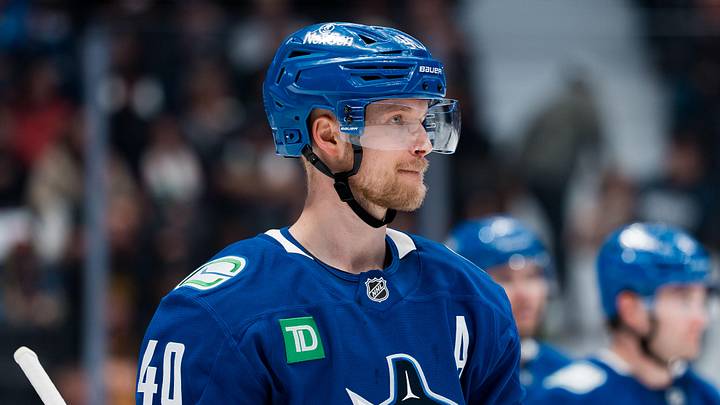
Between November 19, 2024 and December 10, 2024, Elias Pettersson had his most productive ten-game stretch over the last two calendar years. It just happened to occur at the same time as JT Miller's personal leave of absence/"suspension".
Coincidence?
Miller returned on December 12, 2024. Pettersson went pointless in the next six and in ten of the next 12 games.
Coincidence?
What was it about that ten game stretch in the late Fall of 2024 that re-ignited the spark in Pettersson? And if it was solely fueled by the absence of JT Miller from the team, why hasn't Pettersson been dominant after Miller was traded?
The answer is simple: Accountability. When the team acknowledged and punished inappropriate behaviour from the locker room goon, Pettersson excelled. When the team promoted and praised the thuggery while continuing to pile on Pettersson, he was defeated.
The Vancouver Canucks have invested over $110 million in Elias Pettersson. They want him at his absolute best. With the team entering a rebuild, they need more than just the production back. They need his confidence, his skill, his audacity, and his swagger.
Whether Pettersson can become that player again is uncertain. But without both parties admitting responsibility, it is unlikely to happen.
How Pettersson has failed the Canucks
When he signed the most lucrative contract in Canucks history, expectations were naturally going to be high. He will be the first person to admit that he has not met those expectations.
He used a knee injury as a reason for a poor second half of the 2023-24 regular season and subsequent playoffs. He also had to "train around" the knee injury that off-season. The organization felt the knee should not have limited his performance.
The true severity of the knee injury is unclear. But his lack of off-season preparation is obvious. He has not been strong along the boards, he loses balance, and he doesn't move his feet when challenged. Compared to three years ago, his high danger corsi for (HDCF) is down by 30% and his shot attempts are down by 50%. He simply can't get to those areas of the ice as easily.
If Pettersson is truly motivated to return to his form in 2022-23 when he scored 39 goals and 102 points, he needs to commit to an off-season training routine under the direct supervision of the Canucks management and training staff. It should be in Vancouver. He needs to prove that he is willing to do anything to re-establish himself as one of the top centres in the league.
Moreover, he needs to disclose to the training staff if something physical or mental is impairing his performance. He has access to world-class therapies and needs to take advantage of that. Otherwise "I know I can do better" and "I want revenge. I'm not happy with the season that was" will be phrases that sound progressively meaningless.
How the Canucks have failed Pettersson
The organization would never intentionally harm Pettersson but as Greg Wyshynski from ESPN said on a recent appearance on Halford and Brough SN650, "there's probably a percentage of blame [on the organization], right?"
It started in February 2024 when the Canucks "strong armed" Pettersson into signing the contract extension under the threat of trading him to Carolina. Isn't this sentiment the exact opposite of how to treat your star-player? Instead of the "kill him with kindness" approach, they went with the threat of "if you don't sign this now, we will ship you off to wherever we want".
In October 2024 when Pettersson's season started slow, Elliotte Friedman said on the 32 Thoughts podcast, "as great as [Pettersson] is, they need to get him to be tougher." Rutherford, Allvin, and Tocchet tasked team leadership, including JT Miller, to take this on. Brad Richardson warned the Canucks about JT Miller in 2022. "He gets a little off the rails. You’ve got to surround a guy like JT Miller with veteran players, or you’re going to be f****ed".
Does giving "carte-blanche" to the locker room bully, who himself has no control over his own emotions and has the potential to "f**k" up the team, with instructions to "toughen up" the introvert seem like a good idea?
And then for the next several months, all we heard from the Canucks front office was praise for JT Miller and criticisms for Elias Pettersson.
In November 2024, Miller had a "non-physical" confrontation with Tocchet and took a "personal" leave of absence which some insiders believed to be a team suspension. That didn't stop Tocchet from saying "I'm excited, he's excited, the players are excited. He's one of the best players in the league, so when you get a guy like that back in the lineup, it means a lot."
When the Canucks had no choice but to trade Miller in January 2025 because he became far too toxic to the team, Tocchet said, "I have the utmost respect for JT as a person and as a player", "he played his a** off for me".
At the end of season press conference in April 2025 and at the start of the 2025-26 season, they continued to talk glowingly about Miller. "Millsy was a hell of a player for us", "you don't replace JT Miller", "that's a tough guy to let go", "I'm a huge JT Miller fan, we still talk, I love the guy."
This talk only amplified the growth of the malignant cells that remained after JT Miller was excised from the locker room. Two veterans and leaders, Quinn Hughes and Connor Garland, transformed into the same lazy, indifferent, detestable persona as the primary cancer.
Yet, Pettersson continued to get dumped on by coaching staff. "Petey is not getting the message." And dumped on by Allvin. "Everyone's aware that because of injuries or whatever reason, Petey wasn't ready". And dumped on by Rutherford. "He's been disappointing, obviously. I don’t believe he’s put enough preparation in at this point to be the player he needs to be.”
It was constant from his teammates, his coaches, his General Manager, and his President of Hockey Operations. The organization buried Pettersson.
Moving Forward
Ryan Johnson has already spoken to Pettersson "very openly and honestly about my feelings, about his process and some of the adversity and some of the challenges – and there’s a lot of them based on the time he’s been here – but I wanted to hear him speak. I wanted him to be able to speak without judgment, that he knew I was there to listen and not to judge, or to allow him just to speak openly and freely."
This is a fantastic first step, but more is required.
It is clear in the way Johnson speaks that the culture and the communication surrounding the team is going to be different. In subtle ways, he has already expostulated the processes and executions of the previous regime but he needs to be more direct here.
There needs to be public reproval of Tocchet, Allvin, and Rutherford's behaviour. They were wrong in how they approached Pettersson's contract extension. They were wrong in perpetually empowering and praising the locker room bullies. They were wrong in repeatedly and consistently denigrating Pettersson.
A clean slate starts with Johnson digging Pettersson out from the mountain of garbage his predecessors buried him under. This starts with publicly taking accountability.
 Add us as a preferred source on Google