

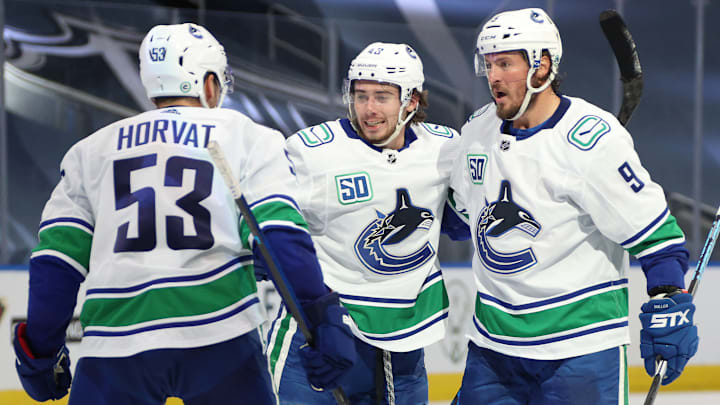
When the Canucks decided to re-sign J.T. Miller in 2022 and trade Bo horvat in 2023, at least they were able to turn Horvat into a very capable defender to pair with Quinn Hughes in Filip Hronek. Unfortunately the Horvat trade may have opened the door for what has followed for the Canucks.
In a relatively short amount of time since trading Horvat, the Canucks have lost a very capable scoring forward in J.T. Miller due to ongoing rifts with other members of the organization, and a generational defenceman in Quinn Hughes due to lacking the top end talent required to compete at a high level within their own conference, while also going through the beginning and end of Rick Tocchet’s relatively successful coaching leadership.
In the midst of this, the Canucks went from a middling team, to a successful team, and back down to a basement team in a short amount of time, and although the team will likely call what they are currently in a “retool,” it is hard to suggest it is anything but a “rebuild.”
Ultimately, the Canucks cannot expect to be successful in the NHL by turning great players into good players over and over again.
We can agree Hronek, Chytil, Buium and Rossi are not Horvat, Miller and Hughes, and no one is saying they have to be, but the Canucks must utilize the experience within their front office and what are likely to be some higher draft selections for the upcoming seasons to furnish their current roster with more top level talent.
General Manager Patrik Allvin has a lengthy background in scouting, as does Jim Rutherford in hockey management, and if Allvin can continue to build on his reasonably successful drafts of late, especially if the Canucks are selecting high in upcoming drafts, it is possible that the Canucks could be better sooner than later.
“Sooner” is still at least a few years away, as the Canucks definitely require top end game changing talent, but the window of opportunity to do so will likely be through the draft, and possibly through trades and free agency.
Short term:
In the near term, the Canucks must focus on being extremely well prepared for the draft, evaluating the current talent on the roster, including lineup fits, and trading expiring players and acquiring assets such as draft picks as well as prospects if possible.
Draft:
As the Canucks sit in the basement of the standings, their chances of getting a higher pick at the draft only increases their odds at landing a generational talent like Gavin McKenna, who is from the Yukon Territory, just north of British Columbia. And if not McKenna, this is still projected to be a strong draft class as there are quality forward options within the top five picks of the draft.
Trades:
The Canucks should consider any trade offer that helps them to either gain young talent and draft capital, but in terms of being immediate sellers they should focus on their own pending unrestricted free agents and even their players who will become free agents after next season.
Current Canucks who are pending unrestricted free agents:
Evander Kane
Kiefer Sherwood
Teddy Blueger
David Kämpf
Current Canucks who are free agents after next season:
Filip Chytil
Drew O’Connor
Tyler Myers
Assessment:
With Hughes now out of the picture, precious minutes, roles, and power play time will be up for grabs on the Canucks. Marco Rossi could be in line to see the most minutes of his career, and possibly more steady power play opportunities as he now becomes the Canucks second most important centre behind Elias Pettersson.
Zeev Buium, who is the most intriguing player the Canucks received the the Hughes trade, will likely see an increase in minutes from his 18:06 per game in Minnesota, while also quarterbacking the Canucks power play as the lone defenceman on the first power play unit.
Beyond the Canucks lineup staples such as Brock Boeser, Conor Garland and Jake DeBrusk, the team must provide minutes, roles and opportunities for their younger and less experienced players and prospects to get the reps, gain confidence, and see what they are good at and what they need to improve upon.
Long term:
The Canucks will need generational game breakers, especially at forward, in order to compete for a Stanley Cup.
Top scoring forwards:
The current edition of the Canucks does not feature any players who are scoring at a point per game pace, and as it stands now the only players on the team to have achieved a season of 60 points or more are Elias Pettersson, Brock Boeser and Marco Rossi.
The drafts of late have featured some great scoring forwards at the top of the draft, and this, plus the trade market and free agency will all be avenues the Canucks can explore in order to address this need.
The NHL salary cap is set to increase to $113.5 after next season, to which the Canucks only have around $68 million committed towards, including Elias Pettersson, Brock Boeser, Jake DeBrusk, Marco Rossi, Garland, Hronek, Marcus Pettersson and Thatcher Demko.
This should allow them to re-sign the recently acquired Buium, as well as pursue trades and free agents in upcoming seasons like Nikita Kucherov, Alex DeBrincat, Nico Hischier, Auston Matthews and Zach Werenski, the kind of talent they must attract in order to stay competitive in the west.
Stability in net:
To be clear, I think Thatcher Demko is a terrific goaltender. Unfortunately due to bad luck with injuries, the talented goalie has been limited to just 36 games since the start of last season, and if the Canucks are to be successful, they cannot be allocating $8.5 million of their cap for each of the next three seasons to a goalie that will only play 40% or less of the time, never mind trying to figure out who is going to be in the crease for them on any given night.
The Rick Tocchet led Canucks saw Demko have a career season in 2023-2024, and had Kevin Lankinen post a career high in starts last year while filling in for the injured Demko, and as the primary starter for the first time in his career, Lankinen had solid results winning 25 of his 49 games started.
The unpredictability of Demko’s injury is what makes this tricky, and perhaps the Canucks would be wise to find two less expensive alternatives to Lankinen’s $4.5 million cap hit should Demko miss an extended period of time again.
The Canucks did also draft Alexei Medvedev in the second round of the draft in June. Medvedev is currently the starting goalie for the London Knights in the OHL, and perhaps Patrik Allvin believes he can be the long term answer for the Canucks in net.
Continuing to develop the talent they already have:
The new wave of quality young players on the Canucks is currently headlined by Marco Rossi, Zeev Buium, Tom Willander, Jonathan Lekkerimäki, Braeden Cootes and goaltender Alexei Medvedev.
If the Canucks hope to be successful going forward, they must ensure that these players are put in the best positions to succeed while continuing to develop and refine their skills. Coaching, analytics, training and nutrition are all vital and widely available in today's game, and injuries and trades aside, there is no reason to believe these players will not contribute to any success the Canucks have in the future.
And by focusing time and resources on the talent the Canucks currently have, it helps unify the organization from management to players and coaches by committing to a direction. The Canucks have know for a while that Hughes “wasn’t going to extend,” and it is better that they resolved this issue now rather than later as the players and team no longer have to deal with the distraction of the Captain’s contract extension.
The Canucks can now begin to form a new leadership, pick a new captain, commit to a specific group of players, and focus on hockey.
But is it a culture problem?
Canucks General Manger Patrik Allvin says he "does not believe the Canucks have a culture problem." Perhaps now that Miller and Hughes are gone the Canucks do not have a culture problem, but I do believe they need to find leadership within their own room and amongst key players who will be with the team for a long time, in order to form the face and identify of the team.
Allvin termed what the Canucks are currently doing as “kind of retooling, rebuilding,” and given the make up of their roster, I would say that is exactly what it is.
 Add us as a preferred source on Google