

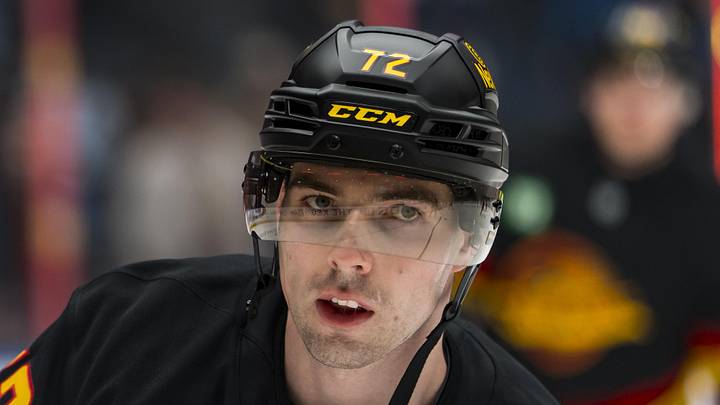
Signing Filip Chytil to an extension this off-season sounds ridiculous. But both the Vancouver Canucks and Filip Chytil want the same thing: have a productive, healthy year on an expiring contract. The most successful way for that to happen is with the security of an additional year to manage his playing time and modify his game to make him less prone to head injury.
Chytil is unlikely part of the rebuild, and not strictly because of his history of head injuries. He will be 27 years old at the start of the season and realistically, by the time the Canucks are contending for a Stanley Cup, he will be past his prime.
When healthy, Chytil is an above-average third line centre. Since 2019-20, he has averaged almost 0.5 points per game. He scored 22 goals and 45 points with only 14:41mins of ice time in 2022-23; the last season he was truly healthy. For his career, his relative xGF and relative Corsi For% indicate that the team performs better when he is on the ice. Because of his skating and puck handling abilities, his controlled zone entries with possession are well-above league average.
But six concussions since 2021-22 has limited him to playing only 78 games in the last three seasons and has crippled his current trade value.
Ownership has made it clear that they want to cut costs. They are not willing to take on bad contracts for assets. They are not willing to overspend on short term contracts for unrestricted free agents who can be flipped at the trade deadline. So, trading veterans is the only way management is allowed to accrue draft picks and prospects.
The key to managing Chytil's asset value is rehabilitating him into a durable and reliable third line centre. Four centres were traded around last years' trade deadline and a healthy Chytil is more valuable than any of them when age and productivity are factored.
Player | Age | Return |
|---|---|---|
Bobby McMann | 30 | 2nd and 4th round picks |
Brayden Schenn | 34 | Conditional 1st round pick 3rd round pick Jonathan Drouin Marcus Gidlof |
Nicolas Roy | 29 | Conditional 1st round pick Conditional 5th round pick |
Nic Dowd | 36 | 2nd and 4th round picks |
A 1 year, $2.5 million contract extension this off-season is a low-risk, high reward investment for both sides provided his playing time next year is managed properly.
The Canucks must balance ambition with caution
Chytil's current contract expires at the end of next season and he becomes an unrestricted free agent. Despite the number of head injuries, he has never even hinted, publicly at least, about retirement. With this persistence and ambition, Chytil will stop at nothing to demonstrate his readiness to play. But this is not sustainable. In each of the last three years, he has suffered a season-ending concussion.
He needs to avoid putting himself in vulnerable positions. On the hit he took from Tom Wilson that effectively ended his 2025-26 season, he was watching the puck instead of assessing the dangers around him.
On this collision with Jesper Fast in November 2023, Chytil is staring down at the puck and skating in a straight line making it easier for the defender to make heavy contact.
Of course, not all of his concussions could have been prevented. This blindsided hit from Jason Dickinson on March 15, 2025 was predatory.
But the science is clear. The risk of recurrent concussion increases with each additional concussion, it may take longer to completely recover from each subsequent concussion, and less force is required to trigger the next concussion.
Avoiding the next concussion is imperative
The coaching staff, strength trainers, and skating instructors need the time to work with Chytil. They need to adjust the way he attacks the offensive zone, modify his positioning along the boards, alter his habit of skating in a straight line and staring at the puck, and re-position his head to increase his awareness of the danger in his close surroundings.
Perhaps they would consider playing him in every other game to start the season. They could avoid playing him in back-to-back games and even sitting him the game after a long flight. Granted, none of these suggestions are science-based but they are logical. Additionally, simple math indicates if he is limited to playing 60% of the games, he inherently reduces his risk of concussion by 40%. And if he learns to play the game in a manner that optimizes his safety, his risk of concussion is reduced substantially further.
A season void of head injury followed by another off-season of symptom-free training would give the organization and him the confidence to play without restriction the following year; a contract year.
Mutually beneficial one-year extension
For Chytil, there is no downside. Even if he didn't make any adjustments and played the full season, how likely is a team to sign him to anything more than a one-year, "show me" contract? Furthermore, after the one year extension, he will only be 28 years old; young enough to still sign a multiyear deal. If he were to have a concussion next season, he would be fortunate to have any offers at all.
For the Canucks, the only disadvantage to this extension is having to pay Chytil if he sustains another concussion. But on a relative scale, this is a small amount of money. The upside however, is massive. If he remains healthy and changes his game to show that staying healthy is sustainable while consistently producing points, his trade value would be considerable.
 Add us as a preferred source on Google